Meridian.
Less power required. Take it as fuel, or take it as speed.
The Meridian propeller and rudder are designed to reduce the power your vessel needs. That reduction can be targeted at your everyday cruise or at your rated top-speed condition: spend it as fuel and cut consumption by about 15% at cruise, or spend it as speed and reach about 5% higher top speed at full power. Same hull, same engine, same gearbox - you choose which matters.
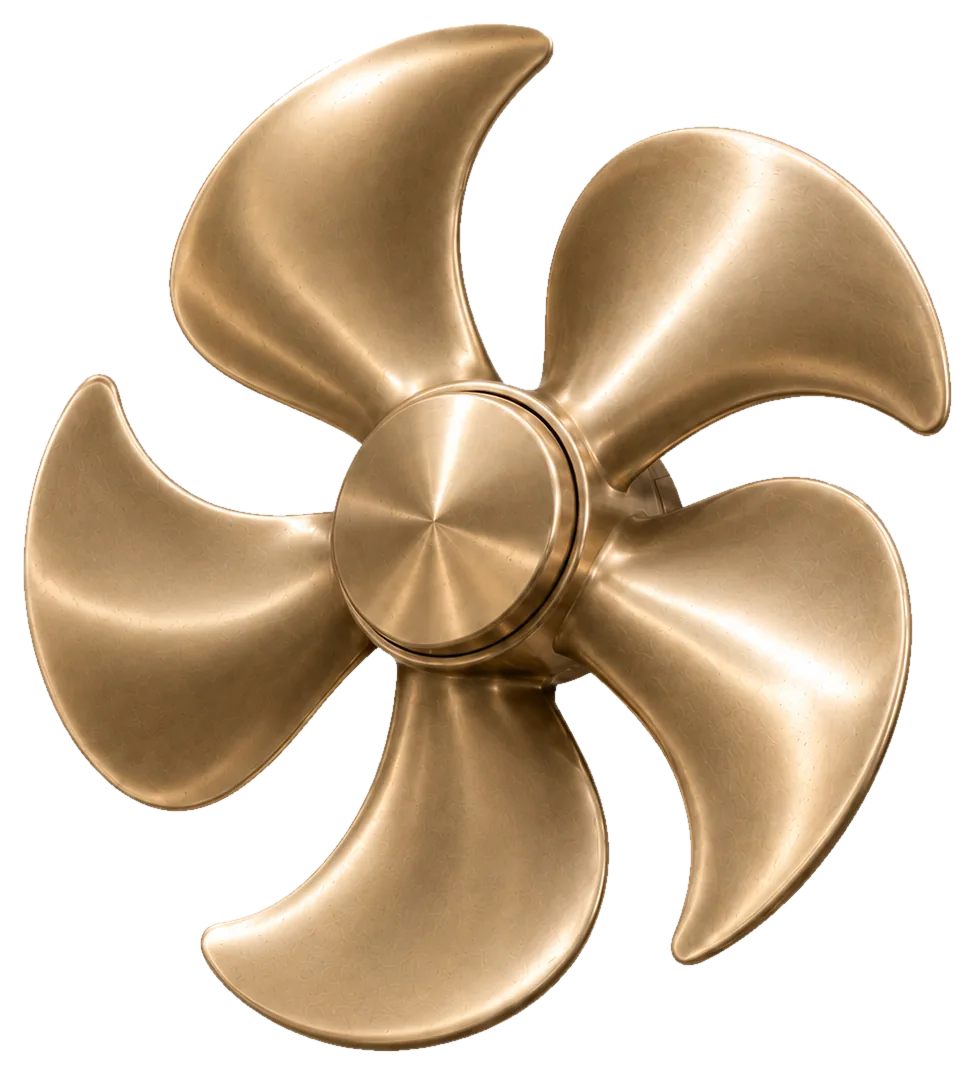
The same technology gives you either about 15% less fuel or about 5% more speed - not both at once. Figures from certified digital-model analysis and CFD; independent sea-trial confirmation is an ongoing project.
Less power required, spent where it counts.
Most propellers are built for a vessel's rated top speed - a speed few vessels actually hold, because draught, weather, traffic and cargo keep them slower for most of their working life. A Meridian propeller is shaped around the speed your vessel really runs, so it needs less power to do the same job.
That saved power is the real prize, and you decide where it goes:
- Set it up for your normal cruising speed and the vessel burns less fuel - about 15% less on the boat we tested.
- Set it up for full speed instead and the vessel goes faster - about 5% higher top speed.
It is the same propeller and rudder either way; you pick whichever matters more. Every design is proven against a certified digital model, so the performance you are shown is measured and verifiable rather than promised - and that model guides every future repair, protecting the gain for the propeller's whole life.
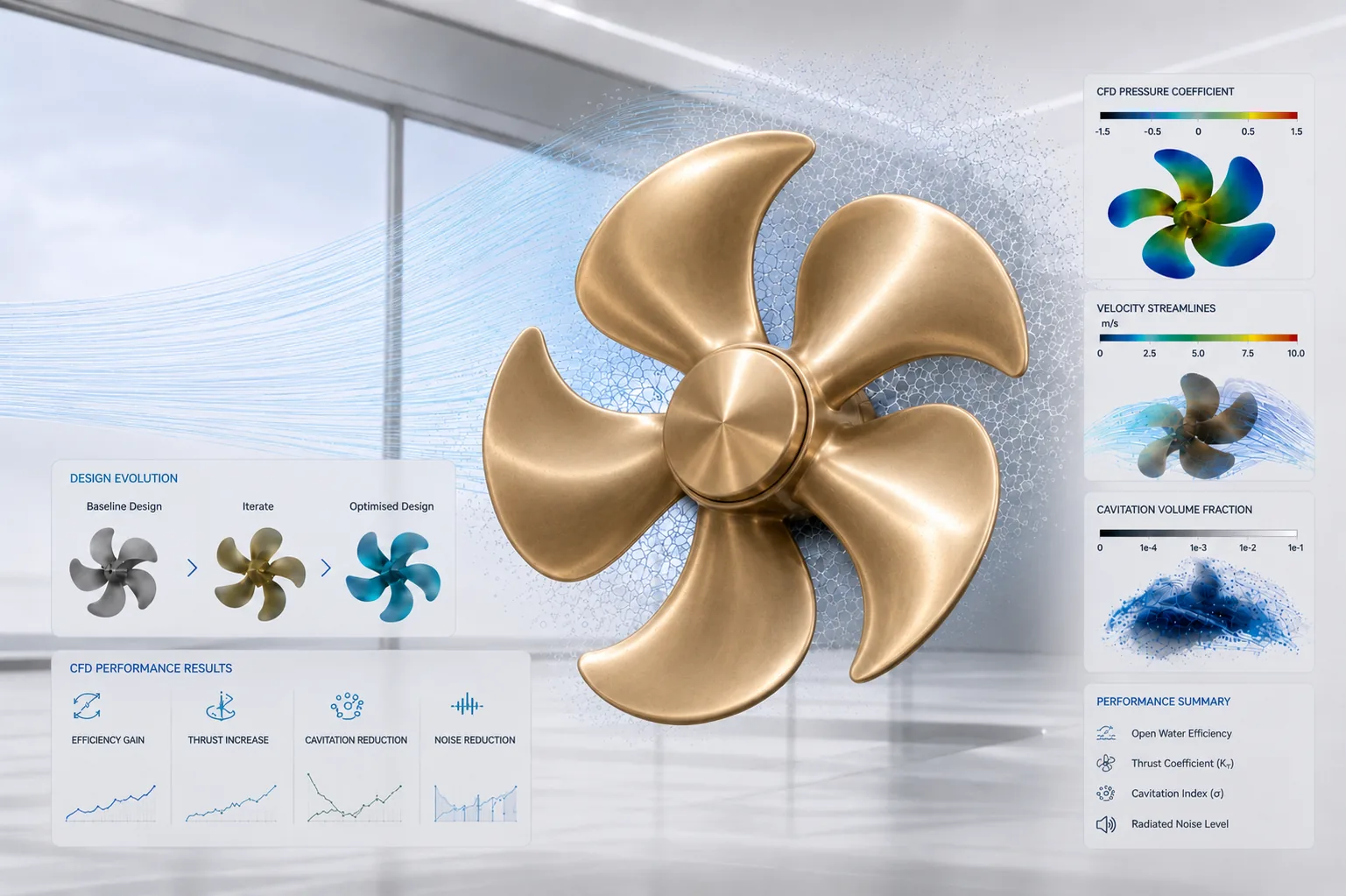
Conventional setup. Meridian system. Same vessel.
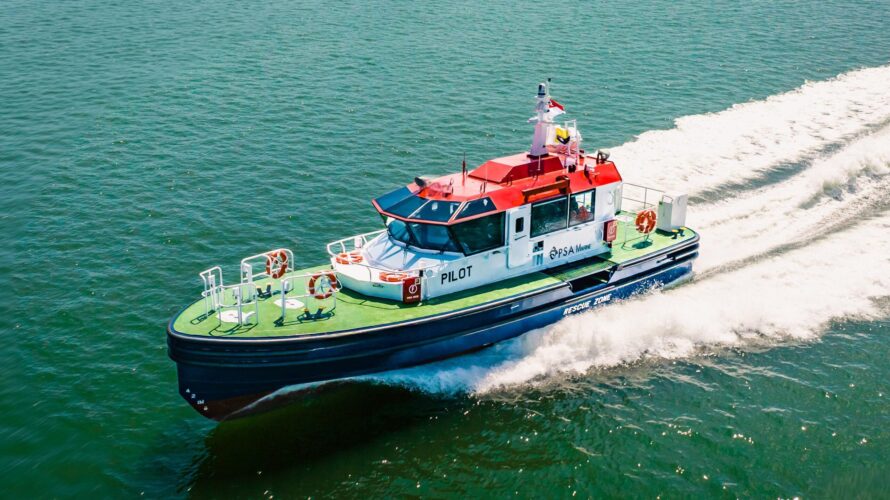
Take the 17 m harbour crew boat: rated for 25 knots, but it spends its working life at a 20-knot cruise. The like-for-like comparison sets the full Meridian system - a propeller re-optimised for the real 20-knot cruise together with the wake-aligned rudder (detailed in the next section) - against the conventional setup built for the rated 25 knots, then evaluates both at that cruise. This is the fuel case; the speed case is its mirror, noted below the table.
| Measured at 20 kt | Conventional setup - built for 25 kt (rated) | Meridian system - built for 20 kt |
|---|---|---|
| Shaft power required | 350 kW | 325 kW |
| Hourly fuel consumption | 91.6 L/h | 77.9 L/h |
| Fuel saving at the real operating speed | - | 14.9% |
| Engine operating point | Further from optimum | Closer to optimum |
Why the fuel saving beats the power saving: the Meridian design also settles the engine on a more efficient point of its fuel curve, so a modest drop in shaft power turns into a larger drop in fuel burned - about 15% less fuel, and the emissions with it, at the real cruise. Or spend it on speed: optimise the same propeller for the rated condition instead of the cruise, and that identical power reduction is spent on speed - roughly 5% higher top speed at full engine power. Independent sea-trial confirmation is an ongoing project.
A rudder shaped to your propeller's flow.
A propeller does not push water straight backwards; it leaves a swirling, rotating wake.
A conventional straight rudder meets that flow at up to about nine degrees across its span, even with the helm centred - driving it into cavitation and adding drag, wasting fuel on every voyage.
A Meridian rudder is shaped to the specific wake of your propeller. Each section along the span is rotated to align with the local swirl, so it meets the water at close to zero angle of attack. Because the swirl reverses above and below the shaft, the twist reverses too - giving the characteristic twisted-leaf form. Cavitation is removed, appendage drag falls, and the saving is delivered at the speed your vessel actually runs.
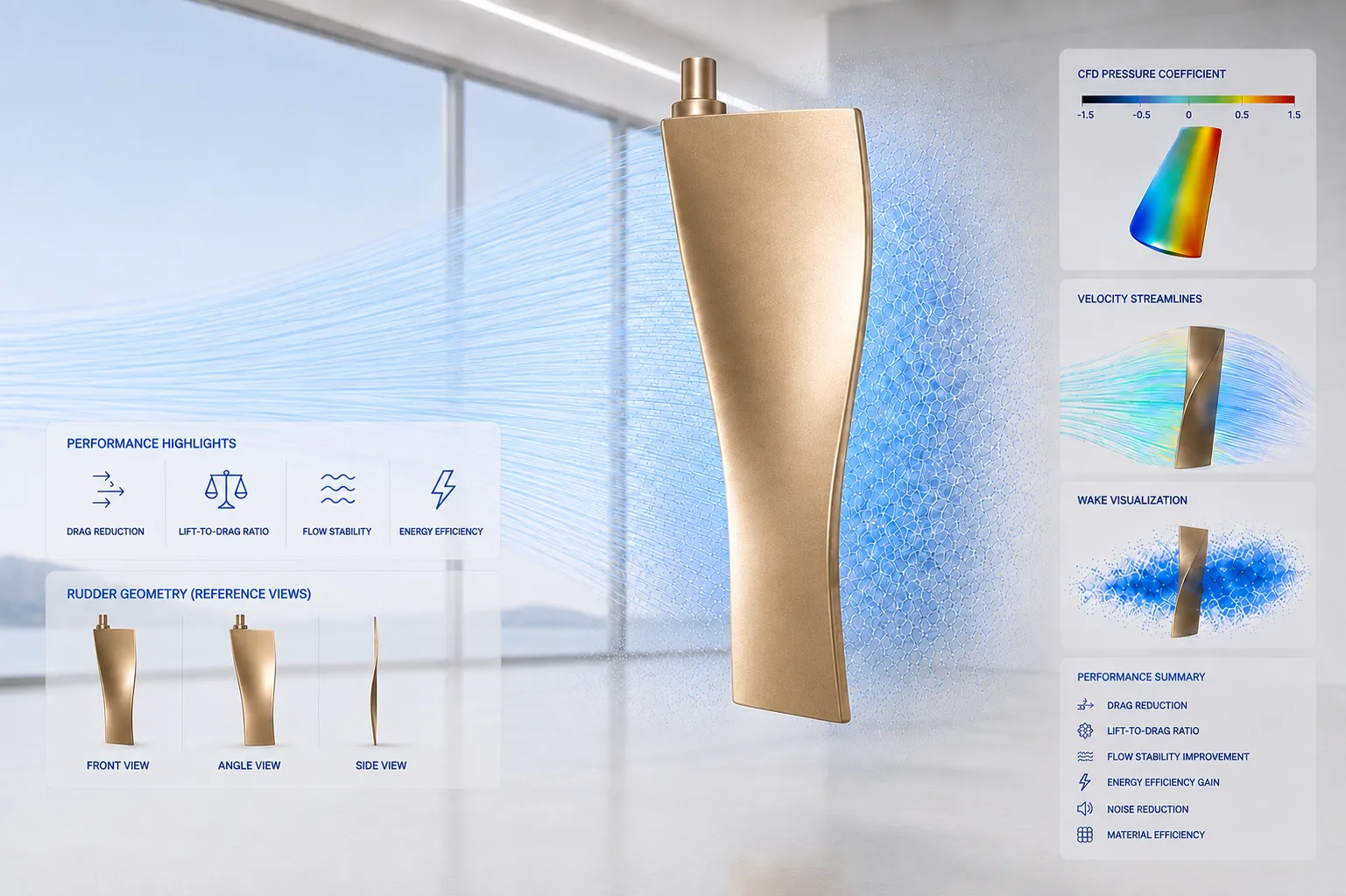
Straight rudder. Meridian rudder. Same propeller.
Like-for-like: the same vessel, the same propeller and the same operating point, with only the rudder changed. At the 20-knot cruise of the 17 m harbour crew boat, the existing straight spade rudder sits in the propeller race at up to about nine degrees of incidence and cavitates over most of its span. The Meridian rudder, aligned to the same wake, runs near zero incidence and does not cavitate anywhere.
| Measure | Straight rudder (existing) | Meridian rudder |
|---|---|---|
| Alignment to propeller swirl | Up to 9° off across the span | Near 0°, section by section |
| Rudder cavitation | Over 50 of 63 span stations | None |
| Appendage drag | Baseline | Reduced |
| Fuel saving, rudder fitted on its own | - | 6.2% (range 2-10%) |
Where the saving comes from: removing that cavitation, together with the lower drag of an aligned rudder, cuts the power the engine must deliver at cruise. Fitted on its own to an existing propeller, the wake-aligned rudder delivers about 6.2% less fuel - with a firm floor near 2% from drag reduction and up to roughly 10% once cavitation avoidance is fully credited. That saving is part of the full-system figure, not added on top of it: the complete Meridian system - a propeller re-optimised for the real 20-knot cruise plus this rudder - reaches about 15% less fuel and emissions at cruise (range 11% to 18%), with no change to hull, engine or gearbox, or that same margin taken as roughly 5% more top speed. Independent CFD and sea-trial confirmation is an ongoing project.
Propeller and rudder, matched as one.
Meridian is supplied as a matched system, not a set of separate parts. The propeller, rudder and shaft line are designed together and tuned to the same operating point, so the gains hold across the whole installation. Each element is made to your vessel, and any part can be built new or renewed to its exact geometry when the time comes.
Meridian propeller
The core of the system
Blade geometry and sections shaped to your vessel's operating profile and proven against the certified digital model.
Meridian rudder & brackets
Aligned to the wake
Rudder and supporting brackets profiled to work with the propeller wake, cavitation-free and lower in drag across the operating range.
Meridian shaft line
Tuned as one
An aligned shaft line that completes the installation as a single tailored system, tuned to the same operating point.
Case Study · In Progress
A 17 m harbour crew boat, redesigned for the speed it really runs.
Rated for 25 knots but working most of its life at a 20-knot cruise, the vessel was burning fuel at a point its propeller was never built for. Mencast redesigned the propeller for that real cruise and added a wake-aligned twisted rudder - no change to hull, engine or gearbox - cutting fuel by about 15% at cruise. Set up for full speed instead, the same saved power would have given about 5% more top speed. Sea-trial confirmation is an ongoing project.
Built to be repaired, not replaced.
The efficiency gain is only worth having if it lasts and the asset stays affordable to own. Meridian is engineered for a long, low-cost service life - with no vendor lock-in.
Material
Nickel aluminium bronze
The established marine propeller and appendage alloy - no proprietary material, no unconventional construction.
No lock-in
Repairable anywhere
Any competent yard can repair, re-pitch or refinish a Meridian blade or rudder using proven techniques.
Renewal
Restored to exact geometry
The same additive process that builds it new renews a worn one back to its proven design geometry, so efficiency is protected through every dry-docking.
Proof
A passport that travels
As-built proof, a Digital Product Passport and sustainability metrics stay with the asset for its whole life.
One product, our whole capability behind it.
Meridian is what the Mencast digital thread produces: designed, manufactured and verified against one certified digital model that follows the asset for life. Here is where each capability comes in.
Intelligent Design
Designed for your vessel
AI searches a far wider design space than manual iteration, weighed against your real operating profile and validated on supercomputing-scale CFD.
Manufacturing & Remanufacturing
Built with less waste
Robotic additive manufacturing adds metal only where the design requires it, and renews a worn part back to exact geometry on the same platform.
Verification & Certification
Proven in the open
Checked back against its digital model and released with a full as-built record, so your own surveyor or class society can verify the performance against the same model we used.
Designed · Proven · Built · Renewed
Talk to us about Meridian.
Bring us your vessel's real operating profile and we will show you the saving before a blade is built. Meridian can be supplied as a matched propeller and rudder, or the rudder alone, shaped to your existing propeller's wake.